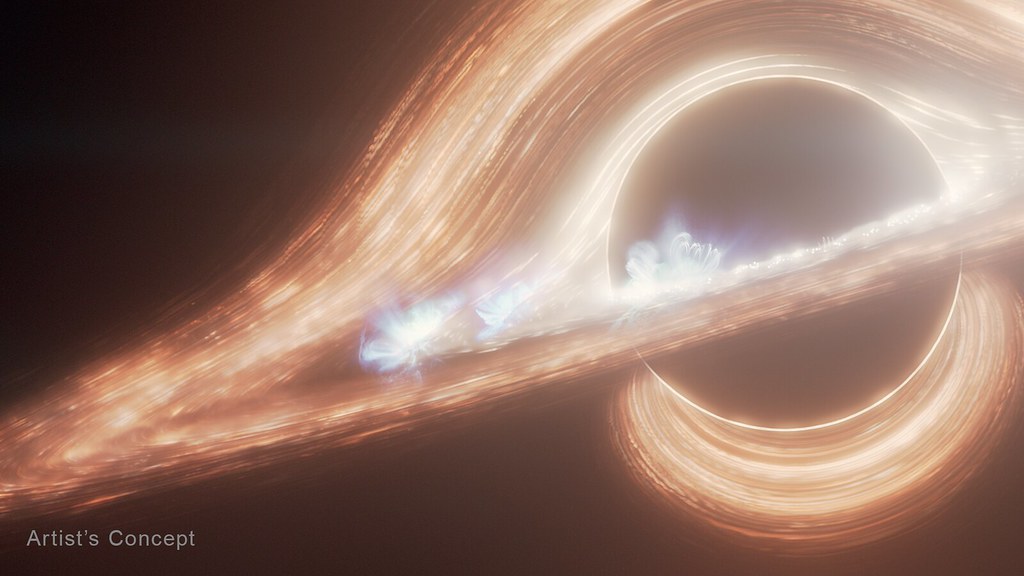
black hole magnetic eruptions are shedding light on new cosmic phenomena. Recent observations suggest these eruptions may resemble solar storms, opening new avenues for research.
Understanding Black Hole Magnetic Eruptions
Recent observations of black holes have revealed intriguing evidence of black hole magnetic eruptions, phenomena that could have significant implications for our understanding of cosmic events. These eruptions are akin to solar storms, which are caused by the Sun’s magnetic field interacting with solar plasma. In the case of black holes, the eruptions occur due to intense magnetic fields generated by the accretion of surrounding matter.
Researchers have identified several key characteristics of these magnetic eruptions:
- Energy Release: Black hole magnetic eruptions can release vast amounts of energy, comparable to that of solar flares.
- Impact on Surrounding Space: These eruptions can influence nearby celestial bodies and potentially affect the formation of stars and planets.
- Magnetic Field Interaction: The interaction between the black hole’s magnetic field and the surrounding environment can lead to complex plasma dynamics.
Understanding these eruptions is crucial for astrophysicists as they provide insights into the behavior of matter under extreme gravitational and magnetic conditions. Furthermore, the study of black hole magnetic eruptions may enhance our knowledge of fundamental physics, particularly in the realms of electromagnetism and general relativity. As research continues, the implications of these findings could reshape our comprehension of both black holes and the universe at large.
How Do Magnetic Eruptions Occur?
Magnetic eruptions around black holes occur due to the complex interplay of gravitational forces and magnetic fields in their vicinity. These eruptions can be likened to solar storms, where intense magnetic activity leads to the release of energy and particles into space. However, the mechanisms behind black hole magnetic eruptions are distinct and involve several key processes.
First, as matter falls into a black hole, it forms an accretion disk. This disk is composed of gas and dust that spirals inwards at high velocities. The friction and compression within the disk generate immense heat and magnetic fields. The resulting magnetic activity can create loops and twists in the magnetic field lines, leading to instability.
Second, when these magnetic field lines reconnect, they release vast amounts of energy, resulting in what we refer to as magnetic eruptions. These eruptions can send shock waves and high-energy particles into the surrounding space, which can have significant consequences for nearby celestial bodies.
Furthermore, researchers have observed that these black hole magnetic eruptions can also influence the interstellar medium, potentially affecting star formation and the evolution of galaxies. Understanding these phenomena is crucial, as they may provide insight into the fundamental processes governing the universe.
In summary, black hole magnetic eruptions are a fascinating area of study, revealing the powerful interactions that occur in extreme gravitational environments.
The Link Between Black Holes and Solar Storms
The relationship between black holes and solar storms is a fascinating area of research that has garnered significant attention. Recent studies highlight that black hole magnetic eruptions may share similarities with the solar storms observed in our own solar system. These eruptions, caused by the intense gravitational and magnetic forces surrounding black holes, can lead to powerful jets of energy and matter being expelled into space.
Scientists are investigating how these black hole magnetic eruptions might mimic solar storms in their dynamics and impacts. Here are some key points regarding this connection:
- Magnetic Fields: Both black holes and the Sun have complex magnetic fields that can undergo sudden changes, resulting in energetic phenomena.
- Energy Release: The energy released during black hole eruptions can parallel the energy output of solar storms, potentially affecting surrounding celestial bodies.
- Impacts on Surroundings: Just as solar storms can disrupt satellite communications and power grids on Earth, black hole eruptions may influence nearby stars and planetary systems.
By studying the mechanics of black hole magnetic eruptions, researchers aim to gain a deeper understanding of cosmic phenomena and their potential impacts on space weather. This knowledge could ultimately enhance our ability to predict and mitigate the effects of solar storms on Earth.
Implications for Astrophysics
The discovery of black hole magnetic eruptions has significant implications for the field of astrophysics. These phenomena not only enhance our understanding of black holes but also provide insights into the broader mechanisms at play in cosmic environments.
One of the most critical aspects of studying black hole magnetic eruptions is their potential to reshape existing theories about energy transfer in the universe. Researchers are beginning to understand how these eruptions can influence the surrounding space, potentially affecting star formation and the evolution of galaxies. This revelation may lead to a reevaluation of models that describe energy dynamics in extreme astrophysical settings.
Additionally, the parallels drawn between black hole magnetic eruptions and solar storms open new avenues for investigation. Scientists can apply knowledge gained from solar phenomena to better comprehend these enigmatic black hole events. This cross-disciplinary approach could lead to groundbreaking developments in our understanding of magnetic fields and their interactions across different celestial bodies.
Furthermore, the implications extend beyond theoretical frameworks. Understanding black hole magnetic eruptions may enhance predictive models regarding cosmic events, thereby improving our ability to foresee potential hazards that could pose threats to space infrastructure and missions.
In summary, the study of black hole magnetic eruptions is poised to influence various aspects of astrophysics, challenging existing paradigms while encouraging innovative research methodologies.
Recent Observations Explained
Recent observations have shed light on the phenomenon of black hole magnetic eruptions, revealing their potential similarities to solar storms. Through advanced imaging techniques, astronomers have captured dynamic activities around black holes that suggest the presence of powerful magnetic fields. These eruptions, which were previously thought to be exclusive to stellar environments, now appear to occur in the vicinity of black holes as well.
One significant finding comes from the study of supermassive black holes at the centers of galaxies. Researchers noted that these black holes can emit jets of high-energy particles that are reminiscent of solar flares. Furthermore, these jets can have far-reaching effects on their surrounding environments, influencing star formation and the interstellar medium.
Key observations include:
- The correlation between black hole activity and the production of magnetic fields.
- The detection of rapid changes in brightness and energy output, indicating explosive magnetic events.
- Evidence that these eruptions can generate shock waves similar to those caused by solar storms.
As scientists continue to study these phenomena, they hope to gain a deeper understanding of the mechanics behind black hole magnetic eruptions and their broader implications for astrophysics, ultimately bridging gaps in our knowledge of cosmic events.
Future Research Directions
As researchers delve deeper into the phenomenon of black hole magnetic eruptions, several future research directions are becoming increasingly clear. Understanding these powerful eruptions not only broadens our knowledge of black holes but also has profound implications for astrophysics and space weather prediction.
One major area of focus will be the development of advanced observational techniques to capture more data on magnetic eruptions associated with black holes. This includes the use of next-generation telescopes and space-based observatories, which can provide unprecedented insights into the dynamics of these cosmic events.
Another important research direction involves theoretical modeling. Scientists aim to create more accurate models that simulate the conditions around black holes and the resulting magnetic eruptions. These models will help bridge the gap between observational data and theoretical predictions, enhancing our understanding of the mechanisms at play.
Furthermore, interdisciplinary collaborations between astrophysicists and solar physicists are essential. By comparing black hole eruptions with solar storm phenomena, researchers can identify common patterns and develop a more cohesive understanding of magnetic activity across different astrophysical environments.
In conclusion, as the field continues to evolve, the exploration of black hole magnetic eruptions holds great promise for unveiling the mysteries of the universe and enhancing our predictive capabilities concerning space weather.
Conclusion on Cosmic Phenomena
In conclusion, the study of black hole magnetic eruptions has opened a new frontier in our understanding of cosmic phenomena. These powerful events, similar to solar storms, challenge our existing theories and prompt a reevaluation of the dynamics at play in the universe.
As researchers delve deeper into the mechanisms behind these eruptions, they uncover potential connections between black holes and other astrophysical processes. The implications of these findings extend beyond theoretical astrophysics; they can influence our understanding of cosmic radiation and its effects on space weather.
One of the most significant impacts of black hole magnetic eruptions lies in their potential to reshape how we perceive the relationship between black holes and their surrounding environments. The energetic bursts generated by these phenomena not only have the capacity to affect nearby celestial bodies but could also provide insights into the life cycles of stars and the evolution of galaxies.
As technological advancements allow for more detailed observations, future research directions will likely focus on identifying and analyzing the conditions that lead to these eruptions. By continuing to study black hole magnetic eruptions, scientists aim to unlock the mysteries of the cosmos and enhance our understanding of the fundamental forces that govern the universe.
Ultimately, the ongoing exploration of these phenomena underscores the importance of interdisciplinary collaboration in astrophysics, as experts from various fields come together to decode the complexities of the universe.
By James Webb Space Telescope via Openverse